


When Bad Bunny launched the Debí Tirar Más Fotos Tour in November 2025, he was supporting an album of considerable cultural weight. Earlier that year, Debí Tirar Más Fotos won the 2026 Grammy for Album of the Year. And it was the first Spanish-language record ever to receive that honor. The tour matched the music’s ambition at every level. With 50+ stadium dates spanning nearly 20 countries across four continents, the production required lighting design that operated at a scale few tours ever reach.
Marcus Jessup was the lighting designer to take on the challenge. His career began at the age of 14 working in a church production environment, one large enough to have involved him in practically every aspect of the craft. That early experience led to a formal education at Indiana State University and Full Sail University. After that, he spent time working with Everlast Productions in Miami, where he built expertise across a broad range of live production disciplines before moving into the touring world. The Debí Tirar Más Fotos Tour represents the largest production of his career to date.
For Jessup, the design process begins not with the lighting rig, but with the stage itself. Then, drawing on the emotional world of the album, the design was built around a duality. This is the ability to move between massive, stadium-filling visual statements and passages of greater restraint and intimacy, always in service of the music and the artist. That range, from spectacle to near stillness, runs as a consistent thread through the full show.
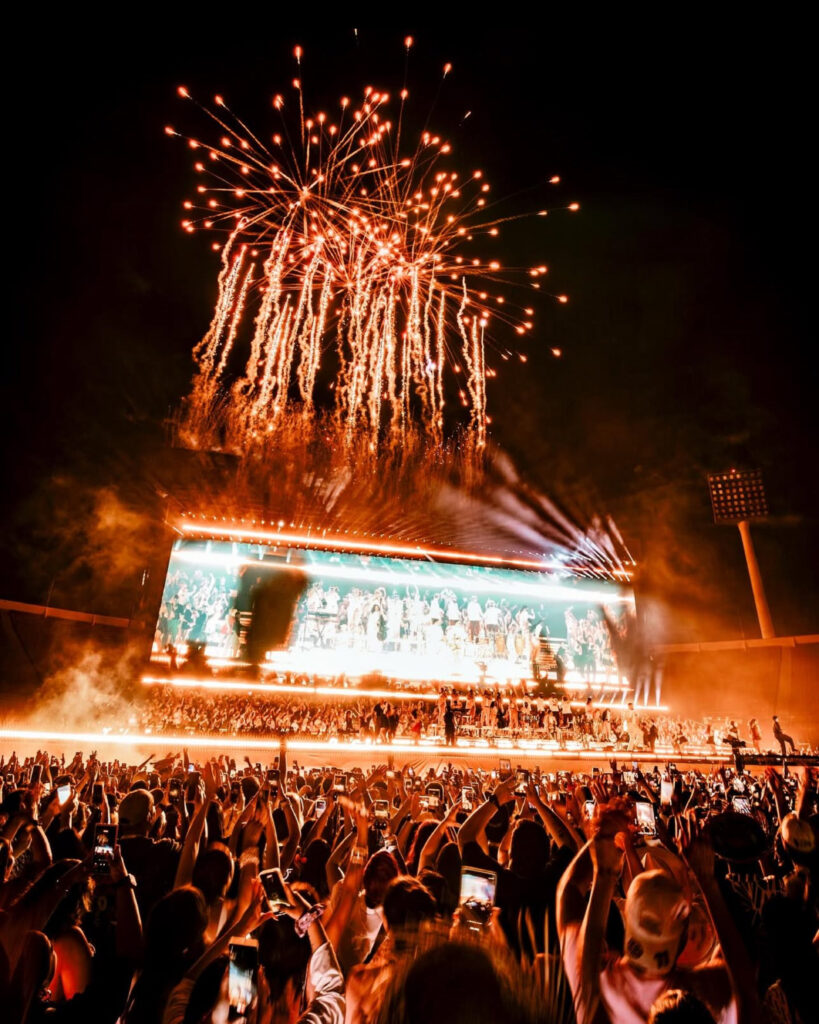
Designing for an entirely stadium-based circuit demands different creative decisions. The scale of the venues opens up opportunities for large-scale visual impact that smaller formats cannot support. However, it also requires a system capable of sustaining quieter, more focused moments without losing presence. A stadium can absorb a great deal of light. The challenge is knowing when to use it and when to hold back.
For the fixture selection across the international dates, Jessup drew on a long-standing working relationship with GLP and specified two products that became central to the design – 136 JDC2 IP and 14 MAD MAXX units. The criteria were clear. It needed to be something big, powerful and visually distinctive. And those GLP fixtures divided that brief between the two of them in very complementary ways.
The MAD MAXX took on the role of defining the show’s outer scale. Producing output of up to about 68,000 lumens through an array of 19 high-powered LEDs, the fixture generates columns of light that read clearly across the full span of a stadium and extend into the open sky above. In those moments, when the 14 MAD MAXX units angle upward in unison, the fixture functions less as a conventional moving head and more as a spatial element in its own right. It was the strongest source in the rig, with the output to cut through every other fixture in the entire design.
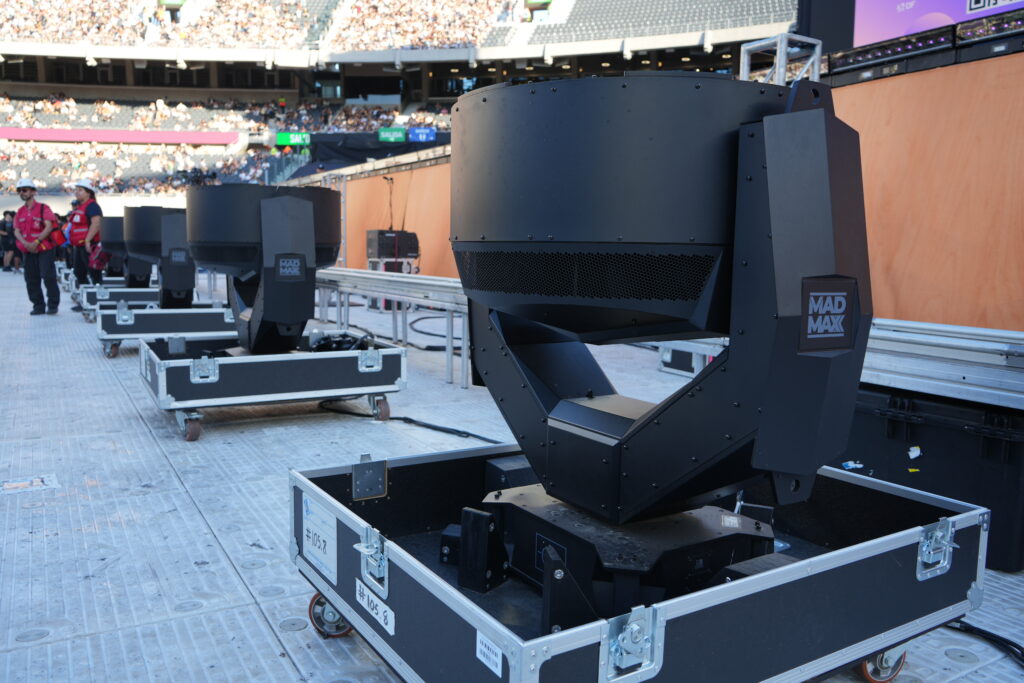
A relatively recent addition to GLP’s range at the time of the tour, the MAD MAXX was also a deliberate choice for its visual novelty. Its beam character, which is reminiscent of the long-throw searchlights of earlier generations, gives the design a distinct look and feel that reads at stadium distances, making its presence felt by audiences across the full width of even the largest venues.
Where the MAD MAXX defined the show’s reach, the 136 JDC2 IP units built its inner rhythm. A hybrid LED fixture combining a high-output white strobe with large RGB color panels and independently controllable segments, the JDC2 IP operates well beyond the conventional strobe role. Its zone-based control enables complex internal animation and movement. This generates visual dynamics and creates layered effects without depending solely on the fixture’s motorized tilt. That combination of strobe intensity and wash flexibility made the JDC2 IP effective across the full dynamic range of the show, as it was equally suited to high-energy passages demanding strong silhouettes and to more contained moments requiring nuanced color and pattern work.
Across both products, the underlying vision for the design remained consistent. Lighting was a tool to support the emotional narrative of the show rather than to overshadow it. The most significant visual moments were often the most controlled, with the scale and output of the rig held in reserve until the music and performance called for it.
Across the international dates of the Debí Tirar Más Fotos Tour, the combination of JDC2 IP and MAD MAXX gave Jessup the range to move between those registers without compromise. One product delivered the reach and presence to fill the world’s largest stadiums, and the other provided the control and versatility to sustain the show’s more precise and intricate visual language.
Photo Credit – © Evangelina Bertello and Movingthroughspaceof