


In a general sense, a microphone is just a microphone.
While we tend to think of particular mics being pegged as “vocal” microphones, and others as “instrument” microphones, oftentimes these distinctions are not significantly different.
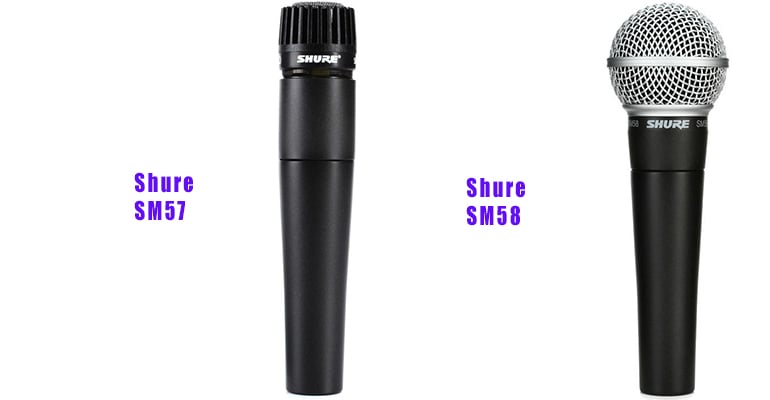
On the other hand, there can be some intentional differences between these two types of mics, which help with their intended purpose. Take, for example, the difference between a Shure SM57 and the Shure SM58 (see figure above).
The SM57 and SM58 both use the same microphone capsule inside (based on the Unidyne III capsule design) and, other than the grille on each, are essentially identical products.
In many cases, you can use either of these Shure microphones interchangeably.
What, then, is the practical difference – i.e., how do we know when to choose one mic over the other? To understand this, consider the difference between what comes out of a person’s mouth, versus how sound emanates from an instrument.
Vocals and instruments both make sound the same way – by causing the surrounding air to vibrate, but vocals also involve a lot of air rushing out of a vocalist’s mouth.
The SM58, designed for vocal applications, has a grille with an integrated windscreen, to help dissipate the sudden rushes of air, so that it doesn’t create an unwanted “pop” sound (plosive) that can happen with any vocalist, or what usually translates into a bassy, distorted sound. An electric guitar amp, on the other hand in a worship band setup, doesn’t create this problem, and therefore doesn’t need a mic with a windscreen – and that’s where the SM57 fits in, among its many other uses.
A primary distinction between vocal and instrument microphones, then, is the integrated windscreen in a vocal mic.
That alone, though, doesn’t mean you can or cannot use an “instrument mic” for a vocalist or vice versa. For example, the SM57 is often used with background vocals and as a talkback mic (so that the worship band can communicate with each other and with one or more audio engineers). The SM58 is often found on drums, electric guitar amp cabinets, pianos, and just about any other instrument.
In other words, if the mic works well – that is, if it sounds good – don’t hesitate to use it.

On the other hand, some microphones actually are specifically designed to be paired with certain instruments. For example, the Audix D6 has a frequency response that is tailored for kick drums (see figure above). Contemporary worship bands often want a punchy “rock” sound from their kick drums, and that typically requires a lot of EQ, when trying to do this with a more general-purpose microphone (like an SM57, which might be more well-suited as a kick mic for bands seeking a subdued drum sound).
Thankfully, to help to avoid needing to use a lot of mixer equalization and other types of processing, a number of manufacturers offer mics with what is essentially a built-in EQ, and the D6 is one with such an option.
The Audix D6’s boost in the low end, extreme midrange dip, and large boost in the top end, accentuate the parts of the kick drum people like for rock, while cutting out a lot the “mud,” or unwanted frequencies that can make some instruments sound “boomy” and “undefined”. In this case, the D6 is an “instrument” mic, because it is quite literally designed to accentuate particular attributes of kick drums (and some other low-pitched instruments), to where it otherwise might not be a good fit being used with other instruments.

An alternative for a kick drum mic might be the Shure Beta 91A (see figure above). This microphone, though, is different in that it is designed to be placed inside the kick drum, to simply rest inside the shell. Like the D6, it has a hyped frequency response, to help us quickly get a good rock kick sound.
Unlike most microphones we typically see or work with for live sound, though, the 91A doesn’t require a mic stand. This brings us to our next feature of many instrument microphones: specialized mounts that both make placement convenient and don’t require stands. We will talk more about that in the second part of this series.
This may be a good time to dispel a common myth about low-frequency pickup capability versus microphone size. All microphones, regardless of the size of their diaphragms, are equally capable of picking up low frequencies. This is why measurement microphones can be flat to 10 Hz, despite having very small diaphragms. I think the myth comes from the fact that larger loudspeaker drivers can more effectively reproduce low frequencies, but the inverse is not true when it comes to microphones, when capturing frequencies across the spectrum.
So far, we’ve covered the primary difference between vocal and instrument mics and delved into details about one particular type of instrument-specific microphone. In the next segment of this series, we’ll dive deeper into some of the more common instrument mic options, and in the final part of this series, we’ll tie it all together by considering how the lines blur between instrument-specific microphones and more flexible, all-purpose mics.
To read the second segment about instrument microphones, click the following link: "Instrument Mics: Mounting Options Matter."
To read the third and final segment about instrument microphones, click the following link: "Instrument Mics: Flexibility, Ears Key To Solution."